01 Jul 2026
Highlights:
How Asset Reuse Is Quietly Becoming a Core Sustainability Strategy
As the aviation industry intensifies its focus on decarbonization and sustainable operations, a less visible but strategically vital trend is gaining traction: circular aviation through asset reuse and teardown strategies. Beyond emissions targets and sustainable fuels, this approach looks at aircraft and component life cycles in a more sustainable, value-maximizing way.
What Is Circular Aviation?
Circular aviation refers to designing and managing aircraft assets with reuse, remanufacturing, refurbishment, and recycling at the center of planning — rather than disposal. It’s rooted in the broader circular economy concept, which aims to keep products and materials in use for as long as possible and extract maximum value before end-of-life handling.
In an industry traditionally focused on linear asset life cycles (acquire → operate → dispose), circular aviation flips the model to deliver both environmental and economic benefits.
Why Asset Reuse Matters for Sustainability
Significant Materials & Energy Footprint
Aircraft are made of high-value materials — aluminum, titanium, composites — whose production is energy-intensive. A 2018 study from the International Council on Clean Transportation (ICCT) estimated that production accounts for roughly 20–30% of total life-cycle emissions for an aircraft (source: ICCT, “Life-cycle aircraft emissions”). Extending the useful life of parts through reuse directly reduces the need for new material production and the associated embodied carbon.
Teardown and Part Out Are Growing
Data from aerospace research providers indicate that the teardown market is growing as aircraft age and retire. For example, Cirium’s 2024 aircraft storage and retirements analysis showed that over 4,000 commercial aircraft were in storage in 2023, providing a large pool of assets for salvage, reuse, and teardown opportunities. (source: Cirium ThoughtCloud)
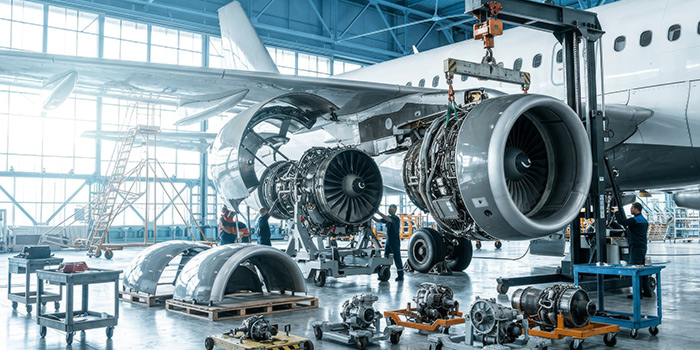
Teardown — the process of disassembling aircraft to harvest usable parts — mitigates waste, supports aftermarket supply, and reduces dependency on new part production.
Component Reuse Reduces Waste and Costs
Used Serviceable Material (USM) is increasingly accepted as a sustainable and cost-effective alternative to new parts — especially under constrained global supply chains. Airlines and MRO providers increasingly rely on USM to reduce inventory costs and accelerate maintenance cycles. USM also avoids emissions associated with producing new components.
Industry sources estimate that using USM can produce up to 40% cost savings compared with new parts in certain categories (source: IATA Cabin Operations Safety Conference, MRO data).
How Circular Aviation Aligns with Broader Sustainability Goals
Supports Emission Reduction Beyond SAF
While Sustainable Aviation Fuel (SAF) remains a priority for carbon reduction, its supply is limited. A 2025 Reuters report cites industry forecasts that even with investments rising, SAF may only represent around 0.7–1% of total jet fuel consumption by 2026 (source: Reuters, “IATA expects sustainable aviation fuel production to double in 2025”). This makes other levers — like lifecycle optimization and circular strategies — essential complements to fuel decarbonization.
Integrates with Global Net-Zero Targets
Leading airlines and lessors include teardown and lifecycle reuse in their sustainability disclosures as part of broader Environmental, Social, and Governance (ESG) frameworks. By quantifying material reuse and longevity, organizations can improve their Scope 3 performance and demonstrate tangible resource efficiency gains.
Enhances Resilience in Supply Constrained Markets
Global supply chains remain uneven, particularly for specialized aviation components. Circular aviation — including teardown, refurbishment, and USM — helps airlines maintain operational resilience when OEM lead times are extended.
Practical Implementation: Where Asset Reuse Adds Value
1. Teardown & Part-Out Strategy
- Disassemble retired aircraft to harvest high-value parts (avionics, landing gear, flight controls).
- Reintroduce parts into the supply chain as USM.
2. Refurbishment & Remanufacturing
- Extend component life through overhaul and upgrades.
- Improve asset lifespan while preserving safety and performance.
3. Data-Driven Lifecycle Planning
- Use reliability and usage data to determine optimal part refurbishment timing.
- Balance cost, performance, and carbon impact.
4. End-of-Life Recycling
- Reclaim metals and composites at end-of-use in ways that reduce landfill waste and support material circularity.
How AviaPro Can Support Circular Aviation Strategies
AviaPro helps aviation stakeholders build and implement circular aviation strategies through:
- Teardown & Lifecycle Analysis: We assess aircraft and fleet portfolios to identify teardown candidates and part-out value potential — helping clients quantify economic and environmental value.
- Asset Valuation With Circular Metrics: Our valuation frameworks incorporate reuse potential and material residuals, delivering a more complete picture of asset economics.
- Maintenance & USM Integration Planning: We help airlines and lessors integrate Used Serviceable Material and refurbished components into maintenance planning — balancing compliance, risk, and sustainability.
- Supply Chain & Operational Advisory: We support operational models that align teardown and reuse with supply chain optimization — ensuring circular options support reliability, cost, and performance goals.
Conclusion
Circular aviation is quietly emerging as a practical sustainability strategy — one that goes beyond emissions targets to reimagine how aircraft and parts are used, reused, and reintegrated into the industry’s lifecycle. In a world of constrained fuel supply, extended OEM lead times, and heightened ESG expectations, asset reuse and teardown are not just good for the environment — they’re becoming wise economic decisions.
The future of aviation sustainability isn’t just fuel — it’s finding value in every stage of an asset’s life.
Sources
- International Council on Clean Transportation, Life-Cycle Aircraft Emissions
- Cirium ThoughtCloud: Aircraft Storage & Retirement Data
- Reuters: IATA expects sustainable aviation fuel production to double in 2025
- IATA / MRO industry cost comparison on USM vs new parts
AviaPro Newsroom
+1 416-544-9969
info@aviaproconsulting.com

Editorial Contacts