24 Sep 2026
Highlights:
In an era of satellite communications, digital air traffic management, and increasingly sophisticated avionics, it's easy to assume that every aspect of aviation relies on advanced technology. Yet one of the industry's most reliable safety systems has remained largely unchanged for decades: control tower light signals. FAA Aeronautical Information Manual (AIM) – Light Gun Signals

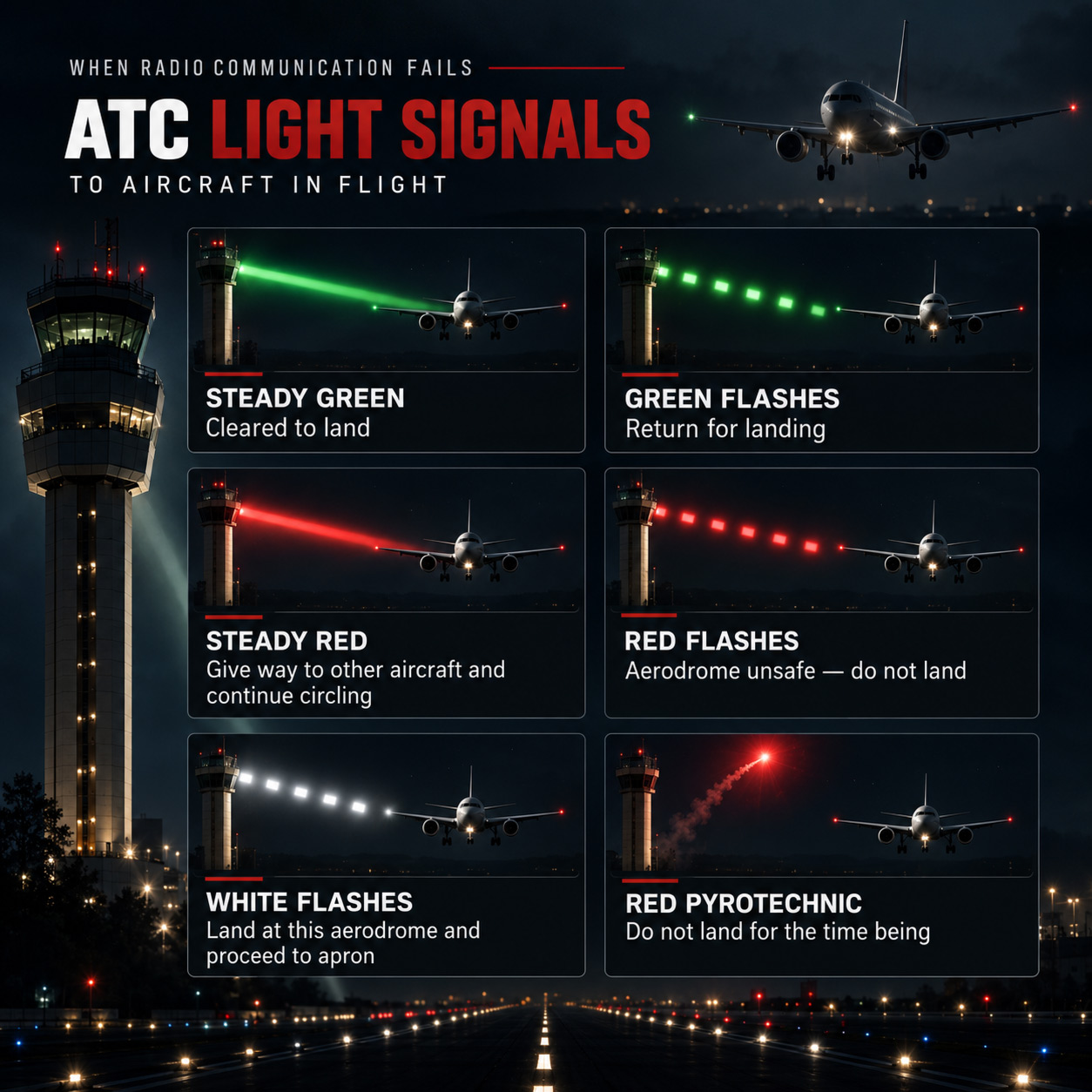
When radio communication between a pilot and Air Traffic Control (ATC) is lost, controllers can use a high-intensity light gun to transmit visual instructions directly to the aircraft. These internationally recognized signals provide clear guidance and ensure that flight operations can continue safely, even without voice communication.
Source: ICAO Annex 2 Appendix 1 (SERA Appendix 1)
When radio communication between a pilot and Air Traffic Control (ATC) is lost, controllers can use a high-intensity light gun to transmit visual instructions directly to the aircraft. These internationally recognized signals provide clear guidance and ensure that flight operations can continue safely, even without voice communication.
For example:
- Steady Green – Cleared to land (or cleared for take-off when on the ground)
- Series of red flashes – Aerodrome unsafe, do not land (or taxi clear of the landing area when on the ground)
- Steady red – Give way to other aircraft and continue circling (or stop when on the ground)
On the pilot's side the procedure is just as simple. The crew sets transponder code 7600 so controllers know the radio has failed, continues in accordance with the communication failure procedures, and watches the tower for light signals. In flight, the pilot acknowledges a signal by rocking the wings by day, or by flashing the landing lights or navigation lights twice at night.
While these procedures are rarely needed, they remain an essential part of pilot and controller training worldwide. FAA AIM – Pilot Communication Failure Procedures
Safety Through Redundancy
One of aviation's greatest strengths is its commitment to redundancy. Every critical system is designed with backup solutions—and often backups to those backups—to ensure safe operations in the event of equipment failures or unexpected situations.
Control tower light signals are a perfect example of this philosophy. Despite today's highly connected aviation environment, pilots continue to train for communication failures because aviation safety is built on preparation for unlikely scenarios, not just routine operations.
As the industry embraces digital transformation, artificial intelligence, and next-generation air traffic management, it is worth remembering that some of aviation's most effective safety measures are also its simplest.
How AviaPro Supports Aviation Safety and Operational Excellence
At AviaPro, we help airlines, airports, operators, and aviation stakeholders strengthen operational resilience through expert consulting services that support every stage of the aviation lifecycle.
Our expertise includes:
- Airport operations and performance optimization
- Operational readiness and transition planning
- Safety and regulatory compliance advisory
- Continuing Airworthiness Management (CAMO)
- Technical due diligence and aircraft transitions
- Fleet management and operational strategy
Whether implementing new technologies or strengthening established operational procedures, our focus is the same: helping clients build safer, more efficient, and more resilient aviation operations.
In aviation, innovation drives the future—but preparedness ensures every flight gets there safely.
AviaPro Newsroom
+1 416-544-9969
info@aviaproconsulting.com

Editorial Contacts