30 Jun 2026
Highlights:
In 2025, aviation capacity constraints did more than delay growth — they accelerated a structural shift in how airlines and Maintenance, Repair, and Overhaul (MRO)s manage maintenance. With aircraft delivery backlogs stretching years into the future, carriers were forced to operate aging fleets longer than planned. The result? Maintenance became continuous, data-driven, and increasingly dependent on smarter Enterprise Resource Planning (ERP) systems.
Aging Fleets Increased Operational Pressure
Global aircraft backlogs now exceed 17,000 aircraft, representing nearly a decade of production at current rates (source: Airbus & Boeing order backlogs, 2024–2025 disclosures; IATA industry briefings). At the same time, the average global fleet age has risen above 15 years, according to the International Air Transport Association (IATA).
Older aircraft typically:
- Consume 15–25% more fuel than new-generation models (IATA industry data)
- Require more frequent heavy checks
- Experience higher component failure rates
- Drive increased demand for spare parts and engine maintenance
With new aircraft arriving slowly, airlines had no choice but to extend the life of in-service assets — increasing pressure on maintenance planning, parts forecasting, and operational reliability.
Static maintenance schedules and delayed reporting were no longer sufficient. When aircraft required frequent intervention, planning had to shift from periodic oversight to real-time control.
Maintenance Became Continuous — and Enterprise Resource Planning (ERP) Became a Capacity Tool
In 2025, capacity was not defined solely by hangar slots or technician headcount. It was defined by information quality and speed of decision-making.
Ongoing global parts shortages — particularly engines and high-value components — forced airlines and Maintenance, Repair, and Overhaul (MRO)s to optimize every maintenance action. According to industry reporting by Reuters and Aviation Week, engine supply constraints and spare parts delays have grounded aircraft worldwide, making maintenance efficiency a revenue-critical factor.
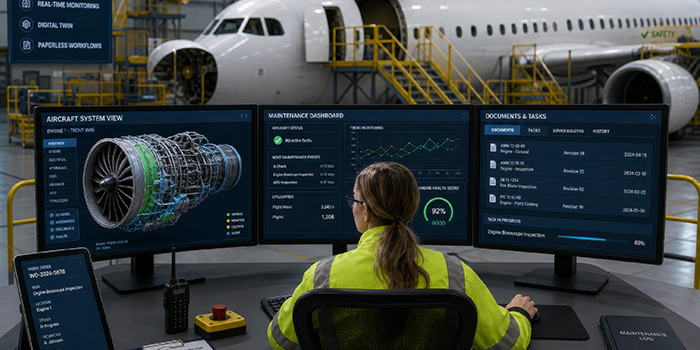
ERP systems evolved from back-office tools into operational control centers, enabling:
- Live work order visibility
- Digital task tracking
- Real-time inventory status
- Repair-cycle transparency
- Forecast-based parts planning
- Condition-based maintenance insights
Better forecasting helped teams determine which parts justified stock investment and which risks could be managed through pooling or repair strategies. Visibility into repair turnaround times reduced uncertainty and minimized aircraft-on-ground (AOG) exposure.
Software became a multiplier of physical capacity.
Mobility Addressed Labour Gaps
Labour shortages remained one of aviation’s most persistent challenges in 2025. According to Boeing’s Pilot & Technician Outlook (2023–2042), the industry will require 690,000 new maintenance technicians globally over the next 20 years. North America and Europe face particularly acute shortages due to retirements outpacing new entrants.
With fewer experienced technicians available, Enterprise Resource Planning (ERP) systems had to become more intuitive and mobile-first.
Key shifts included:
- Paper task cards replaced by digital workflows
- Tablet-based line and hangar maintenance tools
- Guided, visual task instructions
- Simplified user interfaces for faster onboarding
Usability became directly tied to productivity. Systems could no longer assume years of institutional knowledge. Instead, software began supporting technicians with structured workflows and real-time data — reducing errors and accelerating skill development.
In effect, digital tools helped narrow the experience gap.
Regulation Accelerated Digital Adoption
Regulation also played a major role in Enterprise Resource Planning (ERP) evolution.
The European Union Aviation Safety Agency (EASA) introduced Part-IS (Information Security) requirements, mandating that aviation organizations treat operational data protection with the same seriousness as safety oversight (source: EASA Part-IS regulatory framework, 2023–2025 implementation phase).
Manual systems and fragmented legacy software struggled to meet new standards for:
- Access control management
- Audit traceability
- Data integrity
- Cyber resilience
Modern Enterprise Resource Planning (ERP) platforms became essential for compliance — enabling secure data governance without overwhelming operational teams.
Digital transformation was no longer optional; it became regulatory necessity.
The Strategic Shift
The convergence of delivery backlogs, aging fleets, labour shortages, supply constraints, and regulatory pressure created a clear outcome:
Maintenance moved from being a periodic function to an ongoing, data-driven operational strategy.
In this environment:
- Real-time visibility replaced static planning.
- Software augmented workforce productivity.
- ERP platforms evolved into strategic capacity tools.
- Information quality directly influenced aircraft availability and revenue protection.
The aviation industry did not modernize Enterprise Resource Planning (ERP) systems because it was convenient. It did so because constrained fleets demanded smarter decisions — every day.
Sources
- International Air Transport Association (IATA) – Industry Outlook & Fleet Age Data
- Airbus & Boeing – Order Backlog Disclosures (2024–2025)
- Boeing – Pilot & Technician Outlook 2023–2042
- Reuters – Coverage on engine shortages and aircraft groundings (2024–2025)
- Aviation Week – MRO and supply-chain reporting
- European Union Aviation Safety Agency (EASA) – Part-IS Information Security Regulation
AviaPro Newsroom
+1 416-544-9969
info@aviaproconsulting.com

Editorial Contacts